Presentation Template - Session: A Versatile Design Tool
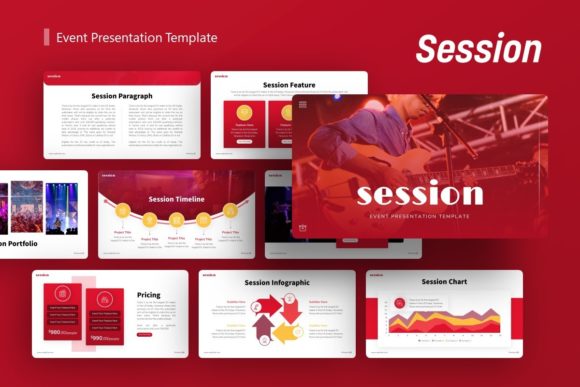
Finding the right balance between visual appeal and functional structure is often the most challenging part of creating a slide deck. The Presentation Template - Session addresses this friction point by offering a comprehensive framework designed for adaptability rather than rigid specialization. At its core, this resource provides 36 distinct slides built on master layouts, allowing users to construct narratives for creative agencies, corporate profiles, startup pitch decks, or personal portfolios without starting from a blank canvas. It serves as a foundational design system within PowerPoint, where handcrafted infographics and pixel-perfect illustrations are fully resizable and editable to match specific branding requirements.
Diverse Applications Across Professional Landscapes
A single template rarely serves every user in the exact same way. The value of the Presentation Template - Session lies in how different professionals interpret and utilize its modular components based on their unique objectives. For a marketing manager at a mid-sized firm, the priority might be speed and brand consistency; they need to update quarterly results without redesigning charts from scratch. Conversely, a freelance photographer evaluating this tool cares less about data visualization and more about image placeholders that respect aspect ratios and negative space. Understanding these varying needs helps clarify whether this asset aligns with your current workflow.
For Entrepreneurs and Startup Founders
When pitching to investors or partners, clarity and narrative flow are paramount. Founders often lack the time to design custom graphics while simultaneously refining their business model. This template supports that high-pressure environment by providing pre-structured pitch deck elements. The included vector icons and infographic slides allow entrepreneurs to visualize market size, revenue models, and user growth without hiring a designer. Here, the primary evaluation metric is commercial viability and speed. The ability to drag and drop content into professional layouts means the focus remains on the business proposition rather than alignment issues or font pairing.
Creative Agencies and Portfolio Builders
Creatives face a different set of challenges. Their presentation must demonstrate aesthetic competence while showcasing client work. For this group, the Presentation Template - Session functions as a portfolio scaffold. The 36-slide variety ensures there is likely a layout suitable for case studies, team introductions, or service breakdowns. Unlike corporate users who prioritize data density, creatives evaluate this template based on flexibility and visual restraint. They need to know if the master slides can be stripped back to let photography take center stage, or if the handcrafted illustrations complement their existing visual identity rather than competing with it.
Educators and Non-Profit Organizations
In educational or advocacy settings, the goal is information retention and accessibility. Instructors and non-profit leaders often need to repurpose content for different audiences, such as students, donors, or community stakeholders. The master slide architecture facilitates this by allowing global changes across multiple slides instantly. If an organization updates its color scheme or logo, the change propagates throughout the deck. For these users, reliability and ease of editing outweigh trendy aesthetics. They assess the template based on how easily complex information can be broken down into digestible visual segments using the included editable graphics.
Evaluating Technical Features and Usability
Beyond specific use cases, practical considerations determine long-term usefulness. Whether you are a beginner opening PowerPoint for the first time or a seasoned consultant, certain technical aspects of the Presentation Template - Session warrant close inspection.
- Master Slide Architecture: The template is based on master slides, which is a critical feature for scalability. Beginners should understand that editing a master slide affects all associated layouts, ensuring consistency. Experienced users will appreciate this as it prevents the "broken slide" phenomenon common in poorly constructed templates.
- Editable Vector Assets: All graphics are resizable and editable. This distinguishes the template from those relying on flattened PNG images. For users who need to tweak colors to match strict brand guidelines or modify chart data dynamically, this feature is non-negotiable.
- Documentation and Support: The inclusion of a documentation file suggests a structured approach to user onboarding. For those less comfortable with design software, this reduces the learning curve. Professionals may view this as a sign of quality assurance, indicating the creator has anticipated user friction points.
- Image Placeholder Logic: The drag-and-drop functionality streamlines the replacement of preview images. Users should verify that these placeholders maintain proper cropping masks, ensuring that inserted photos do not appear stretched or distorted during live presentations.
Aligning the Template With Your Specific Goals
Deciding whether to adopt the Presentation Template - Session requires an honest assessment of your current resources and project scope. Not every project requires 36 slides or handcrafted infographics. If your need is a simple five-slide internal update, a lighter solution might be more appropriate. However, for users building a reusable presentation ecosystem, the depth of this template offers significant returns.
Consider your skill level and available time. Beginners benefit from the guardrails provided by pre-designed layouts, learning design principles through reverse engineering. Intermediate users gain efficiency, bypassing the setup phase to focus on content refinement. Advanced users leverage the master slides and vector assets as a base layer, customizing heavily to create something uniquely their own while saving hours of structural formatting.
Cost-effectiveness also plays a role in this evaluation. For freelancers and small business owners, purchasing a comprehensive template is often more economical than commissioning custom design work. The key is ensuring the template’s style is neutral enough to be adapted or distinctive enough to elevate your current materials. Since demo images are for preview purposes only, users must be prepared to supply their own high-quality visuals. The template provides the vessel, but the impact ultimately depends on the content you pour into it.
Making the Final Decision
Ultimately, the Presentation Template - Session is a tool for communication efficiency. It removes the technical barriers to creating polished, professional slides. If your primary bottleneck is design execution rather than content strategy, this resource directly addresses that gap. By understanding how its features map to your specific role—whether that involves pitching startups, teaching complex topics, or showcasing creative work—you can determine if it is the right foundation for your next presentation. The versatility inherent in its 36-slide structure means it is less about a single look and more about providing a reliable, editable system for diverse storytelling needs.